Hertfordshire's renewed focus on reducing missed CYPMHS appointments
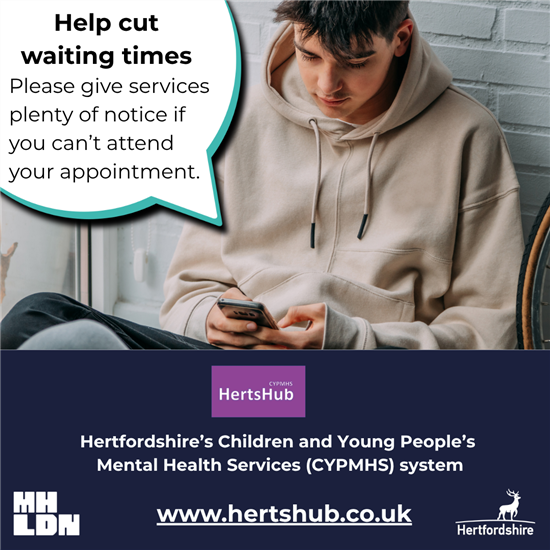 As part of all the work happening at a national and regional level to increase productivity and reduce waiting lists, Herts CYPMHS are renewing their focus on ensuring there is more understanding about the impact of missed appointments on our productivity. We are also making sure that our service providers, “Did not attend” (DNA) and “Was not brought” (WNB) policies and processes are consistent, robust and fully explained to young people, parents and carers at their initial assessment. They also need to be embedded into and discussed as part of the regular clinical supervision process.
Best practice examples for reducing DNA/WNBs
One Herts CYPMHS service provider reduced their waiting times and DNAs significantly by drilling down into their data and reviewing their policies and processes to create an improvement action plan which included:
- A phone call for each referral
- Refining their service criteria and working with other services as part of “waiting well"
- Help from volunteers and university students
- Using digitalised referral forms
- Explaining their DNA policy at the assessment
- Discussing and recording outcome measures on the client’s penultimate session, to allow their last session to focus on their next steps (leaving a service can feel scary).
Another Herts CYPMHS service provider has used parent/carer feedback to improve their feedback forms and letters which now include service information, numbers of sessions, what will happen next and when, what they can do in the meantime, as well as their missed appointments (DNA/WNB) policy. This has resulted in less queries and less DNAs/WNBs.
For more ideas, there is also national NHS guidance regarding DNAs/WNBs here.
In partnership with colleagues working in the Herts CYPMHS system, we have developed some messages for partners to share with colleagues, young people, parents and carers.
The DNA/WNB problem is particularly prevalent in the summer and in December, so we suggest that services share the messages with service users at these times of the year, as well as during their initial assessment. The messages can also be shared in other communications with service users, as well as via different organisation social media channels. The messages will form part of our monthly communications toolkits for communications colleagues in April - August and November - December. Please E: lisa.gazeley@hertfordshire.gov.uk if you would like to be added to the distribution list.